WHY VIETNAM IS BECOMING A STRATEGIC CHOICE FOR EUROPEAN SOFTWARE DEVELOPMENT
Vietnam is becoming a strategic software development destination for European companies, offering up to 40–60% lower development costs than Western Europe without compromising engineering quality. With strong technical talent, flexible team models, and experience working internationally, Vietnam provides an effective balance of cost, quality, scalability, and long-term collaboration.

For European technology companies, software development has become increasingly expensive. Hiring experienced engineers locally requires not only competitive salaries, but also recruitment costs, employment benefits, infrastructure, management, and the ongoing effort required to retain strong technical talent. As products become more complex and development roadmaps become more demanding, maintaining a large engineering organization entirely within Western Europe can place considerable pressure on a company's budget.
This has led many businesses to reconsider how they build their engineering teams. Rather than relying exclusively on local hiring, companies are increasingly looking at international development markets that can provide additional technical capacity at a more sustainable cost.
Vietnam has emerged as one of the markets attracting growing attention.
The reason is not simply that development costs in Vietnam are lower. Many markets across Asia offer competitive pricing. What makes Vietnam particularly interesting for European companies is the balance it can offer between cost efficiency, engineering capability, communication, and long-term collaboration.
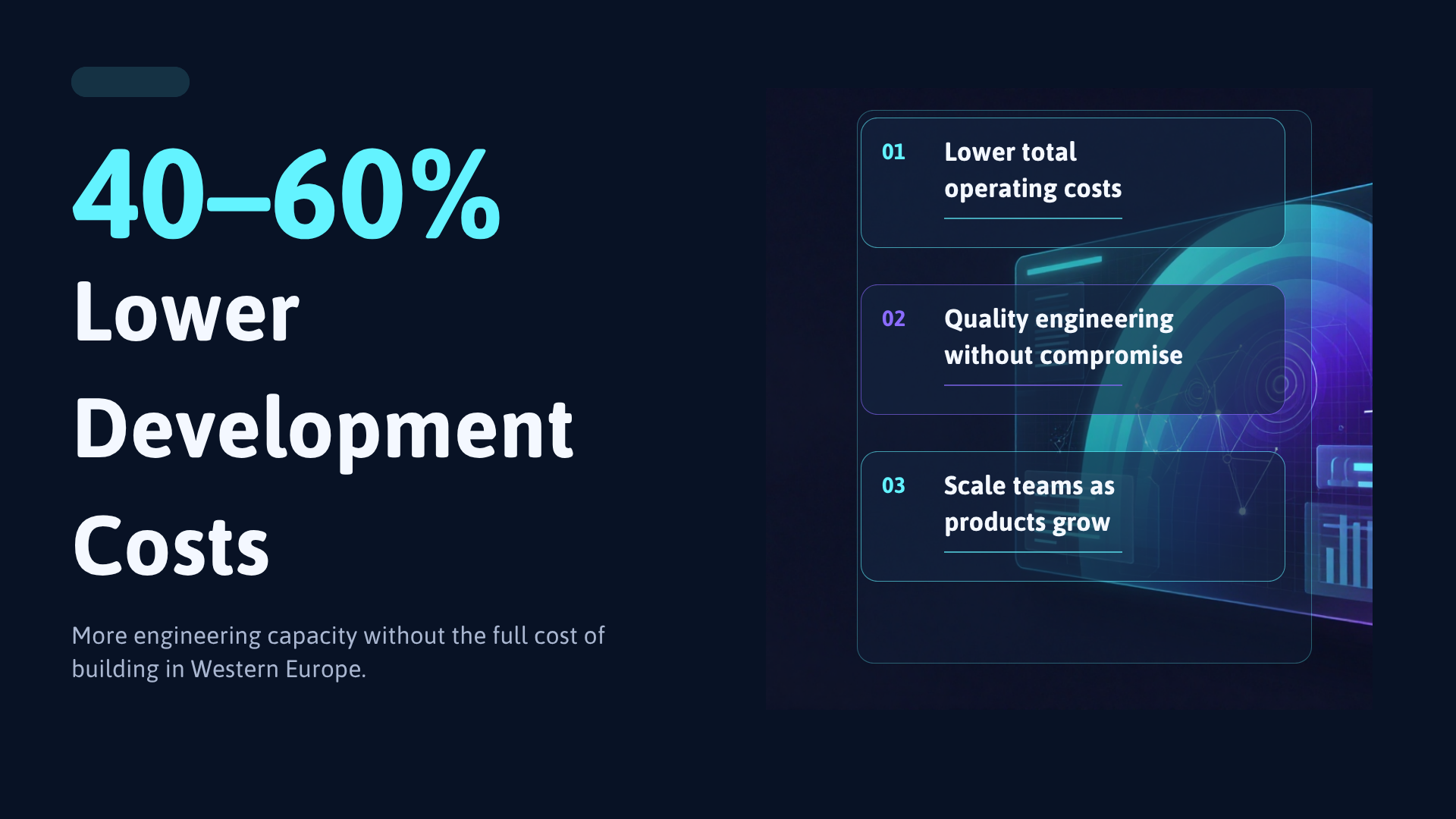
For many European businesses, working with an experienced Vietnamese development team can reduce software development costs by around 40–60% compared with maintaining equivalent engineering capacity in Western Europe, depending on the technology stack, seniority, team structure, and engagement model.
That level of cost efficiency can have a meaningful impact on a company's ability to develop and scale its products. However, the financial advantage only becomes valuable when it is supported by the engineering quality and delivery standards required to build reliable software.
THE RISING COST OF BUILDING SOFTWARE IN EUROPE
The cost of software development in Europe is influenced by much more than developer salaries.
An experienced engineer represents a significant investment once recruitment, employer contributions, benefits, equipment, infrastructure, management, training, and retention are taken into account. For companies competing for senior technical talent, the recruitment process itself can also become a considerable expense, particularly when hiring needs to happen quickly.
The challenge becomes more complicated as the product grows.
A company may initially need only a couple of full-stack developers, but as the platform becomes more sophisticated, additional expertise may be required across frontend development, backend architecture, mobile applications, cloud infrastructure, quality assurance, DevOps, data engineering, or artificial intelligence.
Building all of these capabilities internally can create a substantial fixed cost.
For established companies, this may be manageable. For startups, scale-ups, and businesses operating under tight product budgets, however, increasing headcount every time the roadmap expands is not always the most efficient approach.
This is where an external engineering model becomes attractive.
Instead of continuously increasing internal headcount, a company can maintain its core team in Europe while adding development capacity from a more cost-efficient market.
HOW MUCH CAN EUROPEAN COMPANIES SAVE WITH VIETNAM?
There is no single percentage that applies to every project because the economics depend on the type of development, the experience level required, the team structure, and the way the engagement is managed.
Nevertheless, 40–60% lower development costs compared with equivalent engineering capacity in Western Europe is a reasonable range for many European companies to consider when evaluating Vietnam.
The potential difference can be particularly significant for companies that need several developers over an extended period.
However, this percentage should not be interpreted as a simple comparison between a European developer's salary and a Vietnamese developer's salary. A meaningful comparison needs to consider the total cost of maintaining and operating an engineering capability.
A local employee comes with recruitment, employment costs, benefits, equipment, management, and other operational expenses. An external development team may incorporate many of these costs into its service rate.
The more useful comparison is therefore between the total cost of delivering the required software through each model.
When this broader calculation is made, the cost advantage of Vietnam can become much more significant than a simple salary comparison suggests.
WHY LOWER COST DOES NOT HAVE TO MEAN LOWER QUALITY
There is an understandable concern whenever a company considers offshore development: if the price is substantially lower, will the quality also be lower?
This is a reasonable question.
Software development is not a commodity where the cheapest hourly rate automatically represents the best commercial decision. A developer who requires constant supervision, misunderstands requirements, or produces code that needs substantial rework can ultimately cost more than a more experienced engineer with a higher initial rate.
The real measure of value is therefore not the cost of an individual hour, but the cost of achieving a reliable outcome.
A capable engineering team should be able to understand the product, work within an existing architecture, communicate technical decisions, identify risks, write maintainable code, test its work, and take responsibility for the features it develops.
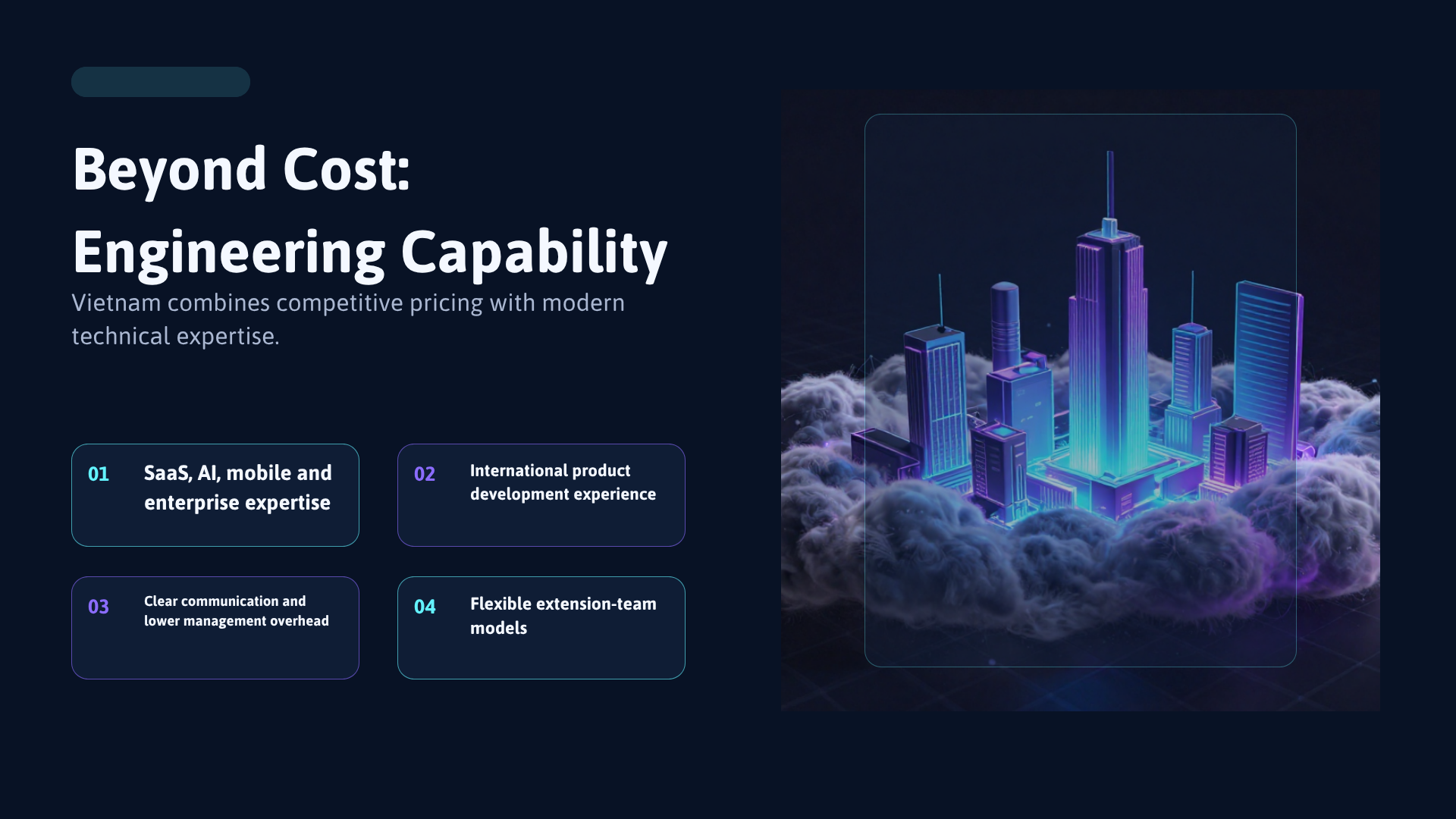
Vietnam's growing technology ecosystem has created a large pool of engineers working with modern development technologies and international clients. This includes experience across web applications, SaaS platforms, mobile products, cloud infrastructure, enterprise software, system integrations, and AI.
For European companies, this creates an opportunity to achieve meaningful cost savings without treating engineering quality as something that must be sacrificed in exchange.
VIETNAM'S POSITION AMONG ASIAN DEVELOPMENT MARKETS
European companies have a wide range of options when considering offshore development.
India and Pakistan have large technology industries, extensive pools of software engineers, and decades of experience serving international clients. Other Asian markets also provide strong technical talent and competitive development costs.
It would be misleading to claim that one country is universally better than another. The right choice depends on the company's requirements, the technology involved, the management model, and the type of relationship it wants to build.
Vietnam's particular strength is the balance it offers.
For companies coming from Western Europe, the development cost can be significantly lower while the engineering ecosystem is sufficiently mature to support modern and increasingly complex software products.
This puts Vietnam in an attractive position between high-cost local development and the pursuit of the lowest possible outsourcing rate.
The objective should not be to find the cheapest country.
It should be to find a market where cost efficiency and engineering capability can coexist.
For many European companies, Vietnam increasingly represents that middle ground.
THE DIFFERENCE BETWEEN CHEAP DEVELOPMENT AND COST-EFFICIENT DEVELOPMENT
There is an important distinction between paying less for development and developing more efficiently.
A company can reduce its hourly development rate and still increase its overall costs if the project suffers from poor communication, weak technical decisions, frequent developer changes, or extensive rework.
Consider a feature that appears inexpensive because it is developed at a very low hourly rate. If the requirements are misunderstood and the feature needs to be rebuilt several times, the initial saving becomes far less meaningful.
This is why experienced companies should evaluate offshore development based on total delivery efficiency.
A good partner should help reduce unnecessary development cycles rather than simply reduce the price of each cycle.
The most valuable engineering team is often the one that can understand the requirement, identify potential issues early, make appropriate technical decisions, and deliver the work with limited supervision.
That is where the real economic advantage of offshore development begins.
WHY VIETNAM IS ATTRACTIVE TO STARTUPS AND SCALE-UPS
For startups and scale-ups, engineering capacity often needs to grow faster than the organization itself.
A new product may require rapid development during the early stages, followed by additional backend, mobile, QA, or infrastructure expertise as the business gains traction.
Hiring each specialist internally can take considerable time and create permanent costs even when the company's requirements later change.
An external Vietnamese engineering team offers a different level of flexibility.
A company can start with a small team, establish a working relationship, and expand the development capacity as the product grows. If the roadmap changes, the team structure can also change without requiring the company to rebuild its entire internal organization.
This can be particularly valuable when the company has strong product leadership in Europe but does not want to significantly increase its local engineering headcount.
Rather than replacing the internal team, Vietnam can provide the additional capacity needed to execute the roadmap.
ONE EXPERIENCED ENGINEER CAN SOMETIMES BE BETTER THAN A LARGE TEAM
Offshore development is sometimes approached with the assumption that more developers automatically mean faster development.
In practice, this is rarely that simple.
A small group of experienced engineers who understand the product can often deliver more effectively than a much larger team that requires detailed instructions and continuous supervision.
For some projects, the most appropriate model may therefore be a single senior developer working directly with the client's CTO or engineering team.
For a larger product, a dedicated team covering frontend, backend, QA, DevOps, or AI may make more sense.
The important consideration is that the team should be designed around the product's actual requirements rather than around the number of resources a vendor can provide.
This is another area where the flexibility of the Vietnamese market can be valuable.
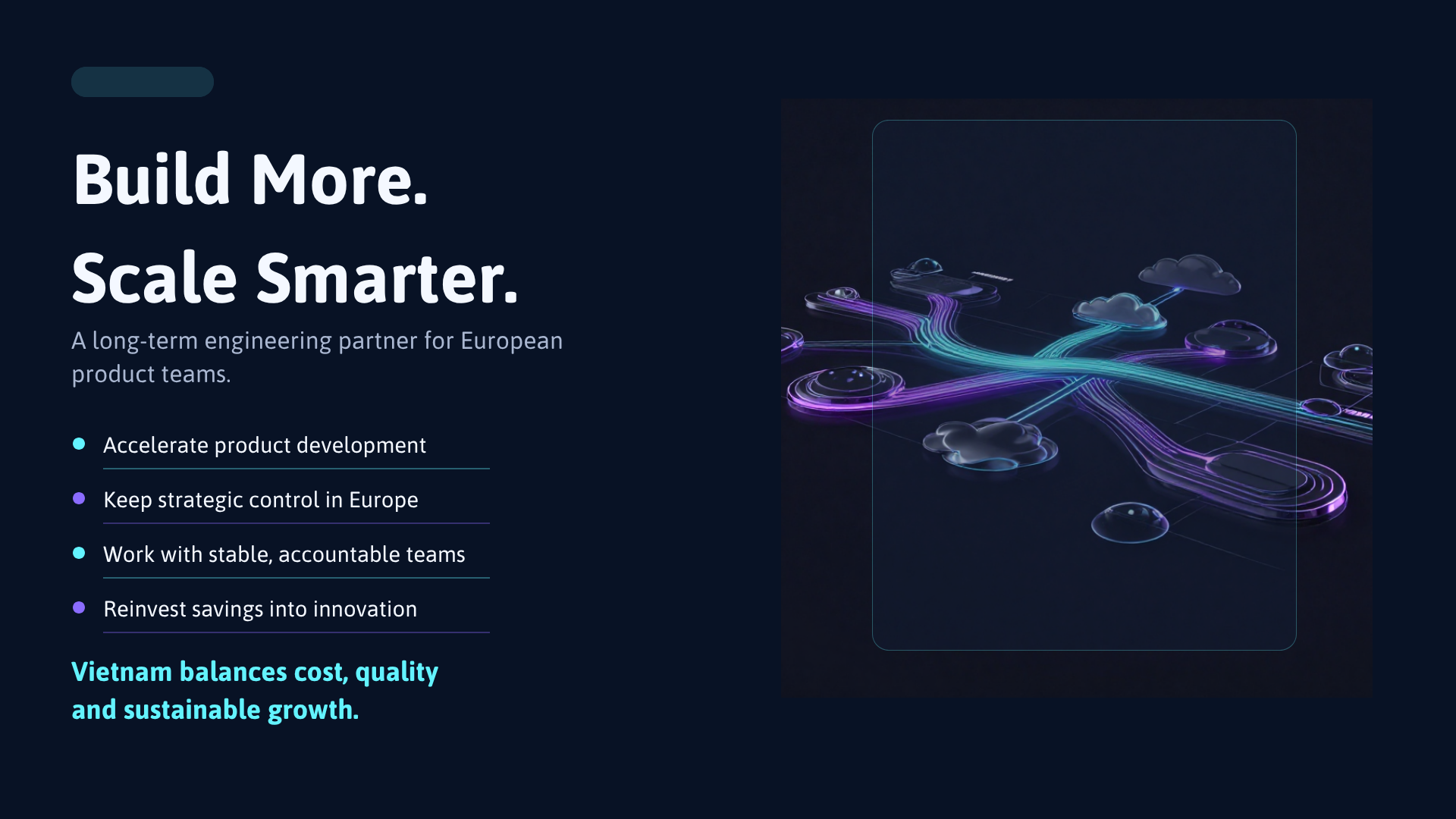
VIETNAM AS AN EXTENSION OF YOUR EUROPEAN ENGINEERING TEAM
The most effective offshore relationships are rarely based on completely separating the internal and external teams.
A stronger model is to treat the Vietnamese engineers as an extension of the existing organization.
The European team can continue to own the product strategy, customer requirements, business priorities, and key architectural decisions, while the Vietnamese team contributes directly to development, testing, integrations, maintenance, and product improvements.
The developers are not simply receiving isolated tasks. Over time, they develop an understanding of the codebase, architecture, business logic, and development standards.
This creates continuity.
It also reduces the amount of knowledge that needs to be transferred whenever a new feature is started.
For long-term products, that continuity can become one of the most important sources of efficiency.
COMMUNICATION IS PART OF ENGINEERING QUALITY
One of the most underestimated factors in offshore development is communication.
Technical capability alone does not guarantee a successful project. Developers need to understand business requirements, clarify assumptions, communicate risks, document technical decisions, and work effectively with product managers and other engineers.
Poor communication can quickly eliminate the financial benefits of outsourcing.
When requirements are misunderstood, work needs to be repeated. When decisions are not documented, knowledge can be lost. When feedback cycles are slow, even relatively simple features can take much longer than expected.
For this reason, European companies should evaluate communication as part of the engineering capability itself.
A strong partner should allow direct communication with the engineers working on the product, maintain a clear development process, and provide enough overlap in working hours to support regular collaboration.
The fewer unnecessary layers between the client and the engineering team, the easier it becomes to maintain both quality and speed.
LONG-TERM COLLABORATION CAN CREATE GREATER SAVINGS
The initial development rate is only one part of the financial equation.
A team that remains involved with the same product for a long period gradually builds knowledge that would otherwise need to be recreated every time a new developer or vendor joins.
The engineers become familiar with the architecture, understand previous technical decisions, recognize recurring problems, and require less explanation for future work.
This reduces onboarding time and allows the team to work more independently.
For this reason, the long-term economics of an offshore partnership can be considerably better than the first quotation suggests.
A slightly higher rate from a stable, experienced team may ultimately be more cost-efficient than a cheaper team that changes frequently or requires significant supervision.
The objective should always be to minimize the total cost of delivering and maintaining the product, not simply to minimize the initial development rate.
WHAT SHOULD EUROPEAN COMPANIES LOOK FOR IN A VIETNAMESE DEVELOPMENT PARTNER?
Choosing Vietnam is only the first step. The quality of the development partner will determine whether the potential cost advantage translates into a genuine business benefit.
Companies should look carefully at who will actually work on the project and whether those engineers have relevant experience with the required technologies and product environment.
Direct communication is equally important. A client should be able to communicate with the people responsible for the development rather than having every technical discussion filtered through multiple layers of account management.
The stability of the team also matters. Constantly replacing developers creates hidden costs because product knowledge has to be transferred repeatedly.
A strong partner should also be able to adapt to changing requirements. Some companies may need one senior developer initially and a broader team later. Others may require frontend and backend support first, followed by QA, DevOps, or AI capabilities.
The engagement model should be flexible enough to accommodate these changes.
Most importantly, the partner should take responsibility for delivery rather than simply supplying development hours.
THE 40–60% COST ADVANTAGE IS ONLY THE BEGINNING
A potential 40–60% reduction in development costs compared with Western Europe is certainly compelling.
But the financial benefit becomes much more meaningful when the company can use those savings to increase its engineering capacity and accelerate product development.
Instead of spending the majority of its technology budget on maintaining a relatively small internal team, a company may be able to combine its European product leadership with a dedicated Vietnamese engineering team and support a significantly broader roadmap.
The additional resources can be invested in new features, product improvements, quality assurance, cloud infrastructure, AI capabilities, or experimentation.
In this sense, lower development costs do not simply mean spending less.
They can mean building more with the same budget.
THE RIGHT QUESTION IS NOT “HOW CHEAP IS VIETNAM?”
When evaluating offshore development, it is easy to focus on the headline rate.
But the better question is not how cheap a developer is.
The better question is whether the engineering model can help the company deliver its product more efficiently.
For European businesses, Vietnam offers a particularly interesting combination. Development costs can be substantially lower than Western Europe, while the country's technology sector provides access to engineers experienced in modern software development and international collaboration.
That makes Vietnam more than a low-cost outsourcing destination.
It can become an extension of a European engineering organization.
The companies that benefit most from this model are not necessarily those looking for the cheapest developers available. They are the companies looking for a sustainable way to increase engineering capacity, control development costs, and maintain the technical quality required for a growing product.
CONCLUSION
The global software development landscape has changed significantly. Companies no longer need to build every part of their engineering organization in the same country where their headquarters are located.
For European businesses, this creates an opportunity to rethink how development teams are structured.
Vietnam offers a compelling option because it combines a significantly more competitive cost structure than Western Europe with an increasingly mature software engineering ecosystem and growing experience in international product development.
For many companies, the potential to reduce development costs by around 40–60% can make a meaningful difference. But the strongest business case is not the percentage itself. It is what the company can do with the additional capacity created by that efficiency.
The goal should not be to outsource simply because it is cheaper.
The goal should be to build software more efficiently, with the right level of engineering quality, while keeping the flexibility to scale as the product evolves.
For European companies looking for that balance, Vietnam is becoming a market that deserves serious consideration.