BUILDING AI RESTAURANT ORDERING SYSTEMS IS HARDER THAN IT LOOKS
Building an AI restaurant ordering system is about more than connecting an LLM to a menu. Discover why understanding customer intent is often the hardest part.
BUILDING AI RESTAURANT ORDERING SYSTEMS IS HARDER THAN IT LOOKS
The restaurant industry is increasingly exploring AI-powered ordering experiences.
From self-service kiosks and mobile ordering apps to conversational assistants integrated into POS systems, businesses are looking for ways to improve customer experiences while increasing operational efficiency.
At first glance, the concept seems straightforward.
Customers ask questions.
AI provides recommendations.
Orders are placed faster and more efficiently.
However, after building an AI ordering solution for a Japanese restaurant POS platform, we discovered that the real challenge is not generating responses.
The real challenge is understanding what customers actually mean.
Beyond AI-Powered Recommendations
Most discussions around AI ordering focus on the model itself.
Can the AI answer questions?
Can it recommend menu items?
Can it communicate naturally?
These capabilities are important, but they represent only a small portion of the overall solution.
Modern Large Language Models can already generate convincing responses.
The real challenge begins when those responses need to be accurate, relevant, and aligned with restaurant operations.
In other words, generating recommendations is easy.
Generating the right recommendations is much harder.
Why Customer Intent Is the Real Problem
Consider a simple customer request:
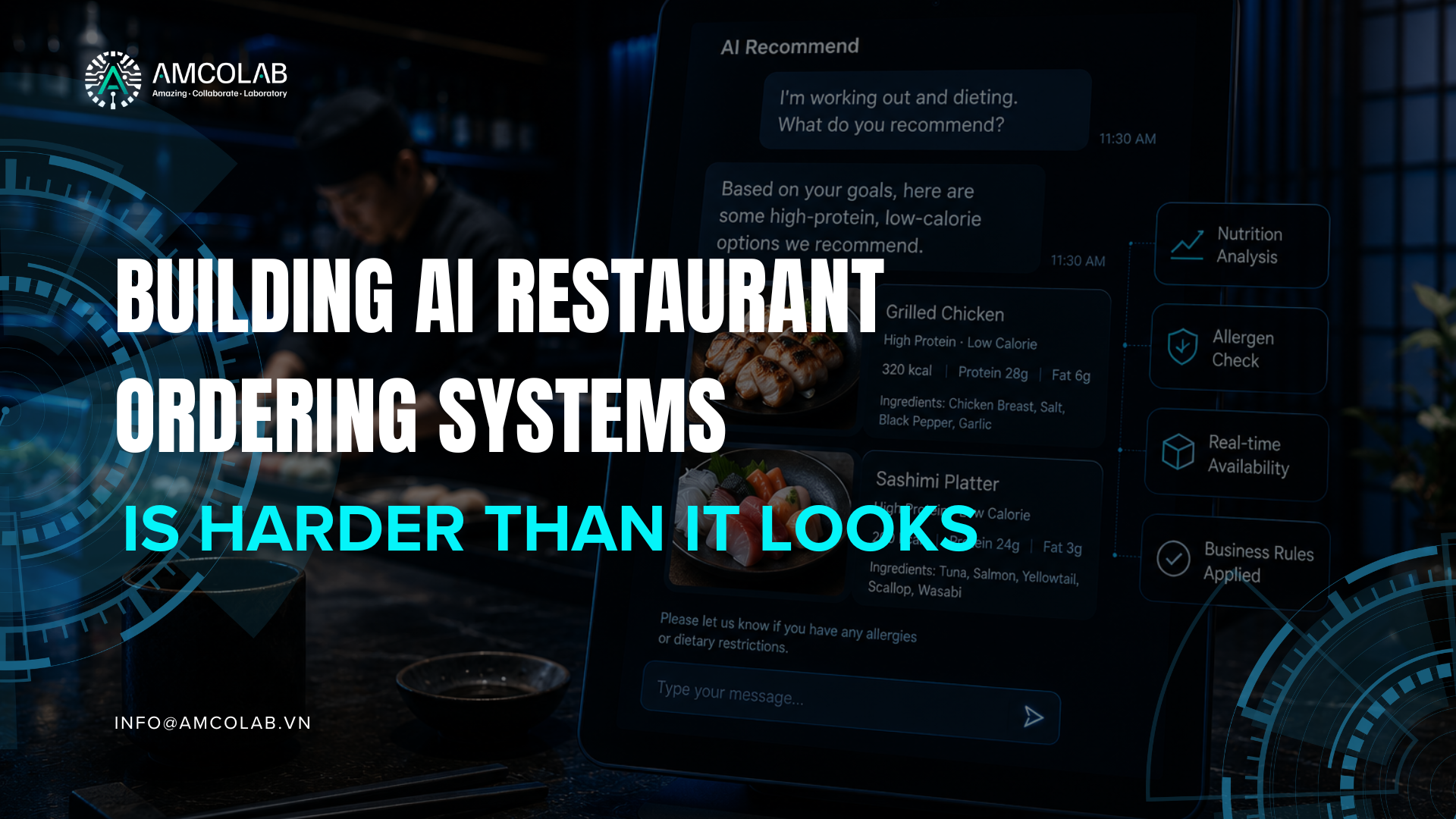
"I'm working out and dieting. What do you recommend?"
An AI system might respond:
"Grilled chicken and sashimi are recommended."
At first glance, the answer seems reasonable.
But from a product and engineering perspective, several questions immediately emerge.
What exactly is the customer's goal?
Are they trying to gain muscle?
Are they trying to lose weight?
Are they focused on increasing protein intake?
Or are they simply looking for healthier menu options?
The answer depends entirely on intent.
And intent is rarely communicated explicitly.
Humans naturally infer meaning through context, experience, and conversation.
Software systems must be designed to do the same.
The Hidden Complexity Behind Simple Requests
The challenge becomes even more obvious when customers use vague language.
Imagine a customer asking:
"Do you have something light?"
This sounds simple.
However, from a system perspective, the request can have multiple interpretations.
"Light" could mean:
Lower calories
Lower fat content
A smaller portion size
Easy-to-digest ingredients
A meal that doesn't feel too heavy
Each interpretation may lead to entirely different menu recommendations.
Without understanding the customer's intent, even a technically correct recommendation may fail to meet expectations.
This is one of the biggest differences between building a chatbot and building a real-world AI ordering system.
Building the Translation Layer
Restaurant operations are highly structured.
Menus contain ingredients, nutritional information, pricing, preparation requirements, inventory constraints, and business rules.
Customers, on the other hand, communicate through preferences, goals, habits, and natural language.
The role of an AI ordering system is to bridge these two worlds.
Before making a recommendation, the system must be able to:
Understand customer intent
Translate intent into structured criteria
Analyze menu and nutritional data
Consider dietary preferences and allergens
Validate real-time menu availability
Apply operational business rules
Generate recommendations that are explainable and relevant
This translation layer is where the majority of complexity exists.
And in many cases, it is significantly more challenging than integrating the AI model itself.
Why LLM Integration Is Often the Easy Part
Many organizations assume that the biggest challenge in AI projects is selecting or integrating the right model.
Our experience suggests otherwise.
Modern AI models are already extremely capable at generating responses.
The larger challenge lies in connecting those responses to real-world business logic.
For restaurant environments, recommendations cannot rely solely on language generation.
They must also account for menu structures, nutritional goals, ingredient constraints, customer preferences, and operational realities.
Without this layer, even the most advanced model can generate recommendations that appear reasonable but fail to deliver actual value.
From Conversations to Operational Decisions
The success of an AI ordering system depends far less on its ability to generate responses and far more on its ability to understand intent.
Customers do not communicate in structured requirements.
They express goals, preferences, expectations, and questions through natural language.
The system's job is to convert those signals into meaningful decisions.
This requires a combination of natural language understanding, business logic, restaurant data, and operational awareness.
Only then can recommendations become both trustworthy and actionable.
The Future of AI in Restaurant Operations
As AI adoption continues to accelerate across the restaurant industry, the greatest opportunities will not come from simply deploying larger models or adding conversational interfaces.
They will come from building intelligent systems that understand customer intent and connect it directly to business operations.
The restaurants that gain the most value from AI will be those that can transform customer conversations into reliable recommendations, operational efficiency, and better dining experiences.
Because ultimately, customers are not evaluating the sophistication of the AI model.
They are evaluating whether the recommendation helps them make a better decision.
How AMCOLAB Helps Businesses Build AI-Powered Restaurant Solutions
At AMCOLAB, we help restaurants and hospitality businesses integrate AI into real-world operations.
Our team develops AI-powered ordering systems, recommendation engines, POS integrations, conversational assistants, and intelligent business workflows that connect customer interactions with operational data.
Whether the goal is to improve ordering experiences, personalize recommendations, optimize restaurant operations, or build domain-specific AI capabilities, we focus on delivering solutions that create measurable business value.
Because successful AI products are not built by connecting an LLM to a database.
They are built by understanding people, understanding operations, and creating the intelligence layer that connects the two.