WHEN NO ONE UNDERSTANDS THE OLD SYSTEM ANYMORE: WHY RESERVE SYSTEM ANALYSIS SHOULD COME BEFORE REBUILDING
When developers leave and documentation vanishes, legacy systems turn into operational risks. This article breaks down why rebuilding without looking back fails, and how a thorough reverse analysis uncovers hidden workflows to save your time, budget, and business logic.
WHEN NO ONE UNDERSTANDS THE OLD SYSTEM ANYMORE: WHY RESERVE SYSTEM ANALYSIS SHOULD COME BEFORE REBUILDING
Many businesses today continue to rely on core operational systems built years or even decades ago. These systems silently power daily business operations - processing orders, managing inventory, tracking customer data, and handling accounting syncs.
The system works, but a silent crisis is developing beneath the surface: the knowledge surrounding it is disappearing.
The original vendor no longer supports the software. The core developers who wrote the initial codebase left the company years ago. Technical documentation is either completely missing or severely outdated. While the operations team knows which buttons to press to get their daily tasks done, no one truly understands how the underlying system processes data.
[Missing Documentation] + [Departed Developers] = High-Risk Legacy System
When a system reaches this state of obscurity, even a minor update or an API integration feels like stepping into a minefield.
Naturally, management's first instinct is to propose a complete rewrite or a total system replacement. However, leaping straight into development without preparation is one of the most expensive mistakes a business can make. Before you rebuild, replace, or maintain, you must first understand what you currently have. This is why reverse system analysis must be your very first step.
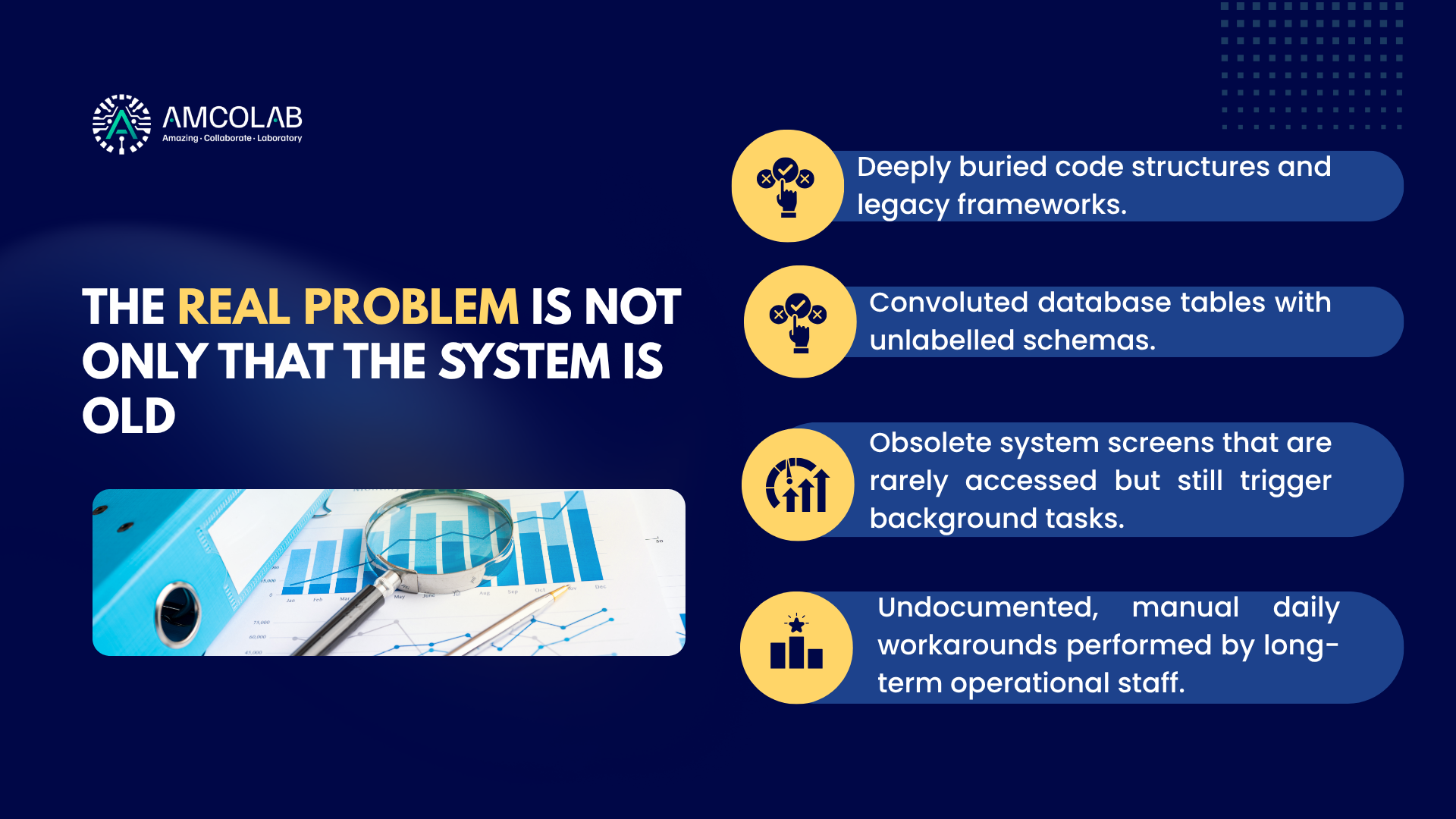
THE REAL PROBLEM IS NOT ONLY THAT THE SYSTEM IS OLD
There is a common misconception that age is the primary issue with legacy software. In reality, many legacy systems developed 10 to 20 years ago remain highly stable, reliably supporting critical business operations every day. They might lack a modern user interface or use older programming languages, but they fulfill their core business purposes perfectly.
The true operational risk arises when no single person in the organization understands the entire system anymore.
Over time, vital business logic and operational knowledge become siloed and trapped within isolated layers:
- Deeply buried code structures and legacy frameworks.
- Convoluted database tables with unlabelled schemas.
- Obsolete system screens that are rarely accessed but still trigger background tasks.
- Undocumented, manual daily workarounds performed by long-term operational staff.
Key Takeaway: A legacy system becomes highly dangerous not because its technology is old, but because your business depends on it while your organization no longer understands how it works.
When you do not know why certain features were built the way they were, predicting how a change in one module will affect another becomes nearly impossible. The system transforms into a ticking financial and operational liability, even while running smoothly on the surface.
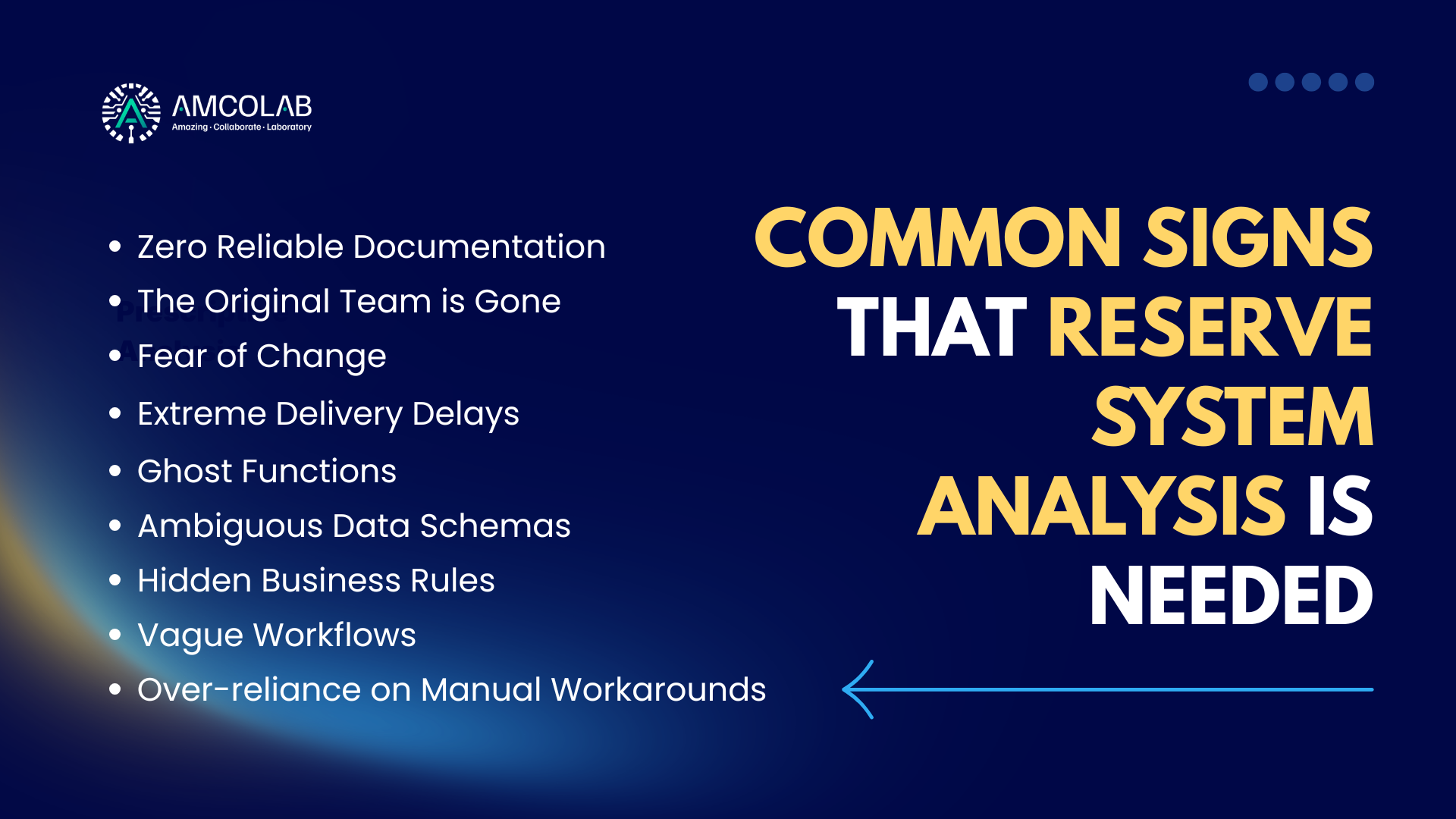
COMMON SIGNS THAT RESERVE SYSTEM ANALYSIS IS NEEDED
Many organizations only realize they have lost control of their system knowledge when they begin planning an upgrade, an API integration, or a full system replacement planning phase.
If your business experiences any of the following symptoms, it is a clear sign that you need to pause and conduct a legacy system analysis:
- Zero Reliable Documentation: Technical manuals, data flow diagrams, and functional specifications do not exist or haven't been updated in years.
- The Original Team is Gone: The original development agency or internal engineers are no longer contactable or available for support.
- Fear of Change: The IT team or internal staff actively avoids requesting modifications because they are terrified of breaking existing workflows.
- Extreme Delivery Delays: Implementing a simple field change or a basic report generation takes weeks or months instead of days.
- Ghost Functions: No one can confidently tell you which software features are still actively used and which ones are completely obsolete.
- Ambiguous Data Schemas: Database column names are cryptic, and no one knows what specific data points actually represent.
- Hidden Business Rules: Core operational rules exist only as hardcoded logic within the software or as tribal knowledge in the heads of senior employees.
- Vague Workflows: You want to rebuild the platform but cannot clearly explain or map out the current end-to-end workflow to a new vendor.
- Over-reliance on Manual Workarounds: Staff constantly use peripheral Excel sheets, manual emails, or paper forms to patch the functional gaps of the core system.
A Real-World Example
Consider an old order management system used by a traditional wholesale business. On paper, it processes standard transactions. In reality, because the system cannot handle modern bulk discounts, the sales team manually updates inventory levels via an Excel sheet, handles approvals through ad-hoc emails, and relies on one senior operations manager who is the only person alive who understands how to handle "edge-case exceptions."
If this business decides to trigger a system replacement project without deeply analyzing these hidden layers, the new, expensive system will completely miss these critical operational requirements - leading to immediate post-launch chaos.
WHY REBUILDING WITHOUT ANALYSIS IS RISKY
Modernization projects rarely fail because of the limitations of the new technology; they fail because developers build the wrong thing due to a fundamental misunderstanding of the legacy architecture.
Skipping the reverse system analysis phase and jumping straight into code creation introduces several critical business risks:
Risk Factor | Business Impact |
Loss of Hidden Business Rules | Decades of specialized business rules, regulatory logic, and custom calculations are wiped out because they only existed inside the old code, not in a brief document. |
Missing Critical Edge Cases | Exceptional scenarios that the legacy system handled quietly for years are ignored, causing the new software to crash or halt operations under real-world pressure. |
Data Migration Failure | Moving legacy data to a new database structure fails entirely if you do not map the true meaning, relationships, and formatting anomalies of the old tables. |
User Rejection | If the shiny new system fails to match the actual, practical pace of daily operations, employees will reject it, turning back to manual workarounds and spreadsheets. |
Exploding Development Costs | Discovering missing core requirements late in the development cycle forces massive design rewrites, scope creeping, missed deadlines, and severe budget overruns. |
Key Takeaway: Rebuilding software without a thorough reverse analysis usually results in a cleaner-looking system that is completely incapable of supporting your actual, real-world business operations. 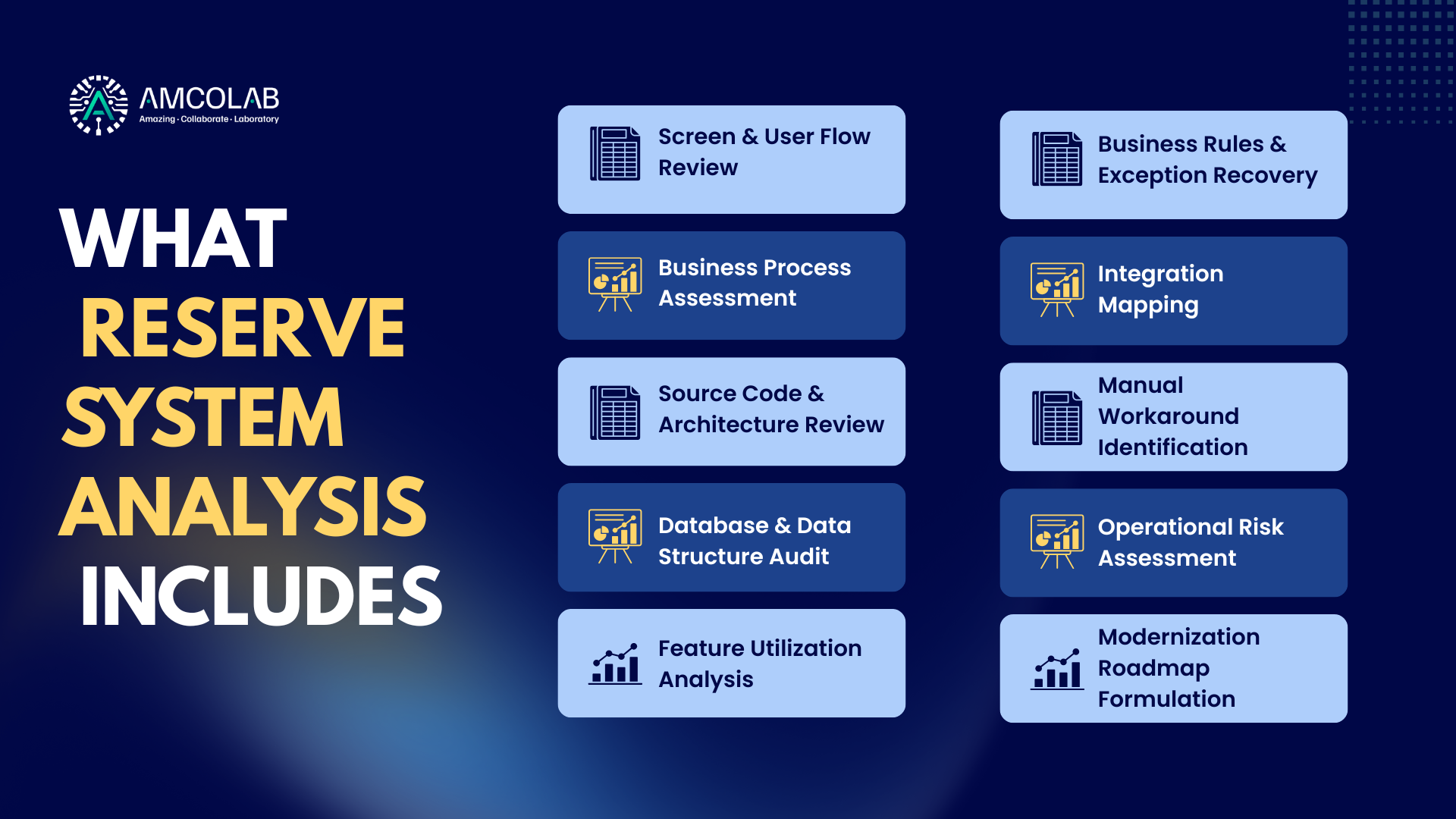
WHAT RESERVE SYSTEM ANALYSIS INCLUDES
The main objective of a reverse system analysis is simple: to recover lost system knowledge and map out the truth of your operations. It is a structured process of digging into the existing system documentation state, looking at what is running, and converting it into a clear blueprint.
An effective analysis framework covers several key layers:
[UI/UX & User Flows] ➔ [Source Code & Architecture] ➔ [DB Schema & Data Flows] ➔ [Manual Integrations & Workarounds]
- Screen & User Flow Review: Mapping how users interact with the system screen-by-screen to understand the practical interface.
- Business Process Assessment: Analyzing what the business actually does around the system, matching human steps with software steps.
- Source Code & Architecture Review: Accessing the legacy codebase to decode hardcoded business rules, detect third-party dependencies, and assess technical debt.
- Database & Data Structure Audit: Inspecting data tables, checking relational integrity, and understanding how data is transformed and stored.
- Feature Utilization Analysis: Isolating highly critical active functions from dead code and obsolete features that do not need to be rebuilt.
- Business Rules & Exception Recovery: Extracting and documenting hidden rules, calculation validation logic, and exception-handling processes.
- Integration Mapping: Tracking every point where the legacy system communicates with external tools, ERPs, CRMs, accounting software, or raw file exports.
- Manual Workaround Identification: Documenting every spreadsheet, email chain, or manual step employees use to complete a system task.
- Operational Risk Assessment: Spotting single points of failure, security holes, and high-risk modules within the current technical environment.
- Modernization Roadmap Formulation: Creating an actionable, risk-managed strategy based on clear technical evidence.
OUTPUTS OF RESERVE SYSTEM ANALYSIS
When you complete a reverse analysis project, you do not just get a theoretical report. You receive an actionable asset package that serves as the foundation for all future legacy software maintenance or system replacement planning:
- Current System Overview: A clear, high-level map of your existing software architecture.
- Comprehensive Function List: An audited catalog of every active feature, classified by business importance.
- Screen Flow & Business Workflow Diagrams: Visual blueprints detailing exactly how data and users navigate the system.
- Data Structure Summary: A clean documentation dictionary explaining your database tables, fields, and core relationships.
- Integration Map: A technical visualization of all internal and external data touchpoints.
- Risk & Opportunity Log: A detailed report highlighting operational bottlenecks alongside quick-win improvement opportunities.
Modernization Scope & Roadmap: A step-by-step phased plan for execution, accompanied by realistic development resource and cost estimates for the next phase.
RESERVE ANALYSIS DOES NOT ALWAYS LEAD TO FULL REPLACEMENT
A major anxiety among business owners is that analyzing an old system will automatically force them into an incredibly expensive, top-to-bottom software replacement.
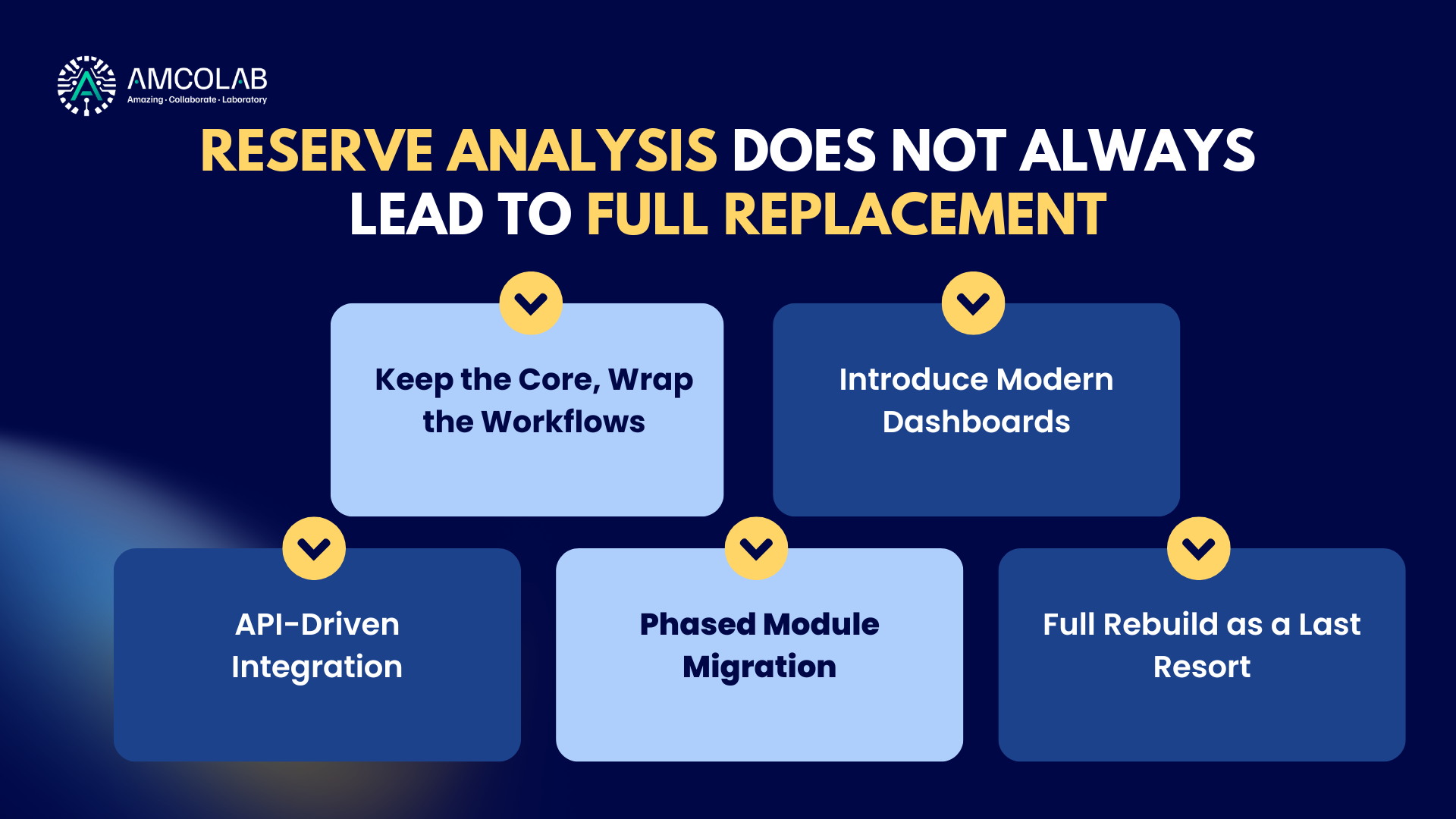
This is completely false. In fact, reverse system analysis is the best way to prevent unnecessary redevelopment costs. By uncovering the true state of the application, you open up multiple highly practical, budget-friendly choices for existing system improvement:
- Keep the Core, Wrap the Workflows: Retain your stable legacy backend system but build modern, custom digital forms or frontends over it to enhance the user experience.
- Introduce Modern Dashboards: Leave the operational database untouched but connect modern BI and data analytics dashboards to extract business insights easily.
- API-Driven Integration: Wrap your legacy modules in clean API layers, allowing old software to seamlessly communicate with modern SaaS tools, CRMs, or ERP setups.
- Phased Module Migration: Avoid the risky "Big Bang" release. Instead, safely move one specific business function (e.g., the billing module) to a modern architecture while leaving the rest intact.
- Full Rebuild as a Last Resort: You only choose a complete rebuild if the reverse analysis proves the underlying system is structurally unsafe, insecure, or financially impossible to maintain.
HOW AMCOLAB SUPPORTS RESERVE SYSTEMS ANALYSIS AND MODERNIZATION
At AMCOLAB, we believe that proposing a brand-new system before understanding your current operational reality is irresponsible tech consulting. We specialize in helping companies safely bridge the gap between legacy reliability and modern scalability.
Our tailored reverse engineering and system modernization engineering services cover every step of your recovery journey:
- System Documentation Recovery: We deep-dive into your undocumented applications to rebuild clear functional and technical specification papers.
- Codebase & Database Auditing: Our technical specialists perform comprehensive source code reviews and database schema mapping to extract forgotten business rules.
- Requirement Recovery & Business Analysis: We shadow your operational teams to extract hidden workflows, undocumented exceptions, and critical peripheral manual processes.
- Strategic Modernization Planning: We design phased, risk-mitigated development roadmaps, whether that involves introducing lean API integrations, building custom software layers, or leveraging highly efficient platforms like Kintone.
- Incremental Replacement & Continuous Maintenance: We provide ongoing legacy software maintenance, create reliable test suites (QA & regression testing), and safely execute step-by-step modular migrations without disrupting your daily business flow.
We don't just write code; we recover your business intelligence, eliminate operational risks, and design smart, realistic engineering roadmaps that protect your bottom line.
CONCLUSION
When a business system grows old, the greatest threat to your enterprise isn't the outdated technology stack. The true danger is the complete loss of institutional knowledge regarding how that system keeps your business alive.
Before you sign off on an expensive, high-risk redevelopment project, take the time to recover that lost understanding. Reverse system analysis brings hidden business logic to light, neutralizes migration risks, saves development capital, and guarantees a safe path forward. In almost every legacy software situation, it is the single most practical, professional, and profitable place to start.
Need to Evaluate a Legacy System Before Modernizing?
If your business is currently running on an old system with missing documentation, or if you are considering a system migration but want to ensure no hidden business rules are left behind, AMCOLAB is here to help.
Let our expert engineering team analyze your existing architecture and craft a practical, low-risk modernization roadmap tailored to your actual business goals.
FREQUENTLY ASKED QUESTIONS (FAQ)
What is Reverse System Analysis in legacy software maintenance?
Reverse System Analysis is a structured process of evaluating an existing, undocumented software system to understand its current architecture, functional layers, data structures, and hidden business rules. Instead of building from scratch blindly, this analysis reconstructs the technical blueprints and operational workflows of your current system to plan a safer modernization path.
Why shouldn't we just rebuild our old system immediately?
Jumping straight into a total system rewrite without prior analysis carries immense system migration risk . Decades of custom calculations, regulatory logic, and unique edge cases are often hardcoded directly into the old software without any existing system documentation . Rebuilding without analyzing these layers usually results in a modern-looking system that fails to handle your actual, daily business operations, leading to scope creep and budget overruns.
Does a reverse system analysis always mean we have to replace our entire software?
No, absolutely not. In fact, a thorough legacy system analysis often prevents unnecessary, expensive replacements. By mapping out the true health of your system, you discover more cost-effective existing system improvement options - such as wrapping your stable legacy backend with modern API layers, building custom frontends, or migrating individual modules step-by-step rather than doing a risky "Big Bang" replacement.
Our original development vendor left and we have zero documentation. Can we still perform a reverse analysis?
Yes. This is exactly where system documentation recovery becomes most valuable. Technical specialists can extract business intelligence by conducting source code reviews, mapping database schemas, analyzing user interface flows, and interviewing your current operational staff to reconstruct the missing requirements from scratch.
How long does a typical legacy system analysis take, and what are the outputs?
Depending on the scale and complexity of the platform, a standard reverse analysis project usually takes anywhere from 2 to 6 weeks. The core outputs include a comprehensive active function list, clear database relationship maps, business process diagrams, an operational risk log, and a step-by-step, risk-managed legacy system modernization roadmap with detailed cost estimates.