STAFF AUGMENTATION VS DEDICATED OUTSOURCING TEAM: THE 2026 GUIDE FOR BUSINESSLEADERS
Choosing between Staff Augmentation and a Dedicated Outsourcing Team isn't just about comparing hourly rates - it's about finding the right delivery model for your business. This guide breaks down the key differences, compares costs, management responsibilities, and operational risks, and helps you determine which approach best supports your technology roadmap and long-term growth.
STAFF AUGMENTATION VS DEDICATED OUTSOURCING TEAM: THE 2026 GUIDE FOR BUSINESSLEADERS
As businesses continue investing in digital transformation, one question comes up again and again:
Should you extend your existing engineering team through Staff Augmentation, or partner with a Dedicated Outsourcing Team?
Many companies compare these two models based solely on hourly rates. In reality, cost is only one part of the equation. The way your team is managed, how knowledge is retained, and who takes responsibility for delivery can have a much greater impact on the success of your project than the development rate itself.
Choosing the wrong engagement model can lead to management overload, slower delivery, or expensive rework later in the project. Choosing the right one gives your business the flexibility to scale while keeping development predictable.
Let's look at how these two models differ and when each one makes the most sense.
What are these models?
Before comparing them, it's important to understand what you're actually paying for.
Staff Augmentation
With Staff Augmentation, you're adding individual engineers to strengthen your existing team. These developers work as an extension of your organization. They join your sprint planning, attend your daily meetings, use your development tools, and report directly to your Project Manager or Tech Lead. Your internal team remains responsible for planning, task allocation, code reviews, and overall delivery.
In short, you're purchasing additional engineering capacity while keeping full control of the project.
Dedicated Outsourcing Team
A Dedicated Team is a different engagement model. Instead of hiring individual developers, you work with a technology partner that provides a complete engineering team, typically including developers, QA engineers, and a team lead. Depending on the project, business analysts, solution architects, or DevOps engineers may also be involved.
Your business continues to define the product vision and priorities, while the outsourcing partner takes responsibility for managing day-to-day execution and ensuring the product is delivered according to plan.
Rather than simply adding resources, you're investing in a complete delivery capability.

Head-to-head comparison
The biggest difference between these models comes down to control versus ownership.
- With Staff Augmentation , you stay in complete control of the daily work.
- With a Dedicated Team , the vendor assumes much of the delivery responsibility, allowing your internal managers to focus on higher-level business decisions.
Dimension | Staff Augmentation | Dedicated Outsourcing Team |
Daily Management | Developers report directly to your internal PM or Tech Lead | A vendor-side Team Lead manages day-to-day execution |
What You're Buying | Individual specialists to strengthen your team | A complete cross-functional engineering team |
Best Fit | Filling short-term skill gaps or accelerating existing projects | Long-term product development and evolving roadmaps |
Onboarding | Usually 1–2 weeks per engineer | Requires a short discovery and onboarding phase |
Knowledge Retention | Project knowledge depends heavily on individual developers | Knowledge stays within the dedicated team through documentation and collaboration |
When each model makes the most sense
Neither model is inherently better. The right choice depends on your project, your internal capabilities, and how much management capacity you have available.
When Staff Augmentation is the better option:
Staff Augmentation works best when your engineering organization is already functioning well and simply needs extra support.
+ You need specialized skills: Sometimes your team only lacks one specific capability. Perhaps you need a DevOps engineer to improve your CI/CD pipeline, an AI specialist to integrate an LLM into your product, or an experienced Flutter developer to accelerate a mobile release.
Hiring specialists through staff augmentation allows you to fill those gaps quickly without expanding your permanent headcount.
+ You're working against tight deadlines: If your roadmap is already defined and your development process is running smoothly, adding experienced engineers can increase delivery speed without changing how your team operates.
Instead of waiting months for permanent recruitment, new developers can usually join within a few weeks.
+ You have strong internal leadership: Staff augmentation delivers the best results when your Project Managers and Tech Leads have enough bandwidth to guide additional engineers.
External developers still require onboarding, technical direction, code reviews, and regular communication. If your managers have the time to support them properly, the model can scale very efficiently.
When a Dedicated Team is the better choice:
A Dedicated Team becomes more valuable when the challenge goes beyond adding a few developers.
+ You're building a long-term product: Projects that continue for six months or longer naturally evolve over time. Requirements change, priorities shift, and new features emerge as customer feedback arrives.
A stable team that stays together throughout the project develops a much deeper understanding of the product, making planning more accurate and reducing unnecessary technical debt.
+ Your internal managers are already fully occupied: Not every company has the capacity to manage a larger engineering team. If your managers are already balancing multiple projects, adding more developers may create additional coordination rather than increasing productivity.
A Dedicated Team removes much of that operational burden by handling planning, execution, testing, reporting, and day-to-day management on your behalf.
+ You're working with legacy systems: Modernizing an undocumented legacy system requires much more than writing code.
The team often needs to analyze existing software, uncover hidden business rules, document complex workflows, and gradually rebuild the system without disrupting daily operations.
This kind of work benefits from a stable engineering team that owns the entire discovery and modernization process rather than relying on individual contractors.
Cost structure and operational risk
Comparing these two models based only on hourly rates can be misleading because the financial responsibility is distributed differently.
Staff Augmentation
- Staff Augmentation is usually billed per engineer on an hourly or Time & Materials basis.
- The initial cost often appears lower because you're paying only for the developers you need.
However, your organization also carries most of the delivery risk. If priorities change, onboarding takes longer than expected, or an engineer leaves the project, your internal team is responsible for absorbing those delays and managing the transition.
Dedicated Team
- Dedicated Teams are typically billed as a fixed monthly team capacity or through milestone-based agreements.
- Although the monthly investment is generally higher, it includes much more than developer hours. You're also paying for engineering management, quality assurance, team stability, and structured delivery processes.
The outsourcing partner assumes much of the operational responsibility, including maintaining team continuity, transferring knowledge between team members, and keeping delivery on track.
For larger projects, this often results in lower overall costs by reducing rework, delays, and management overhead.
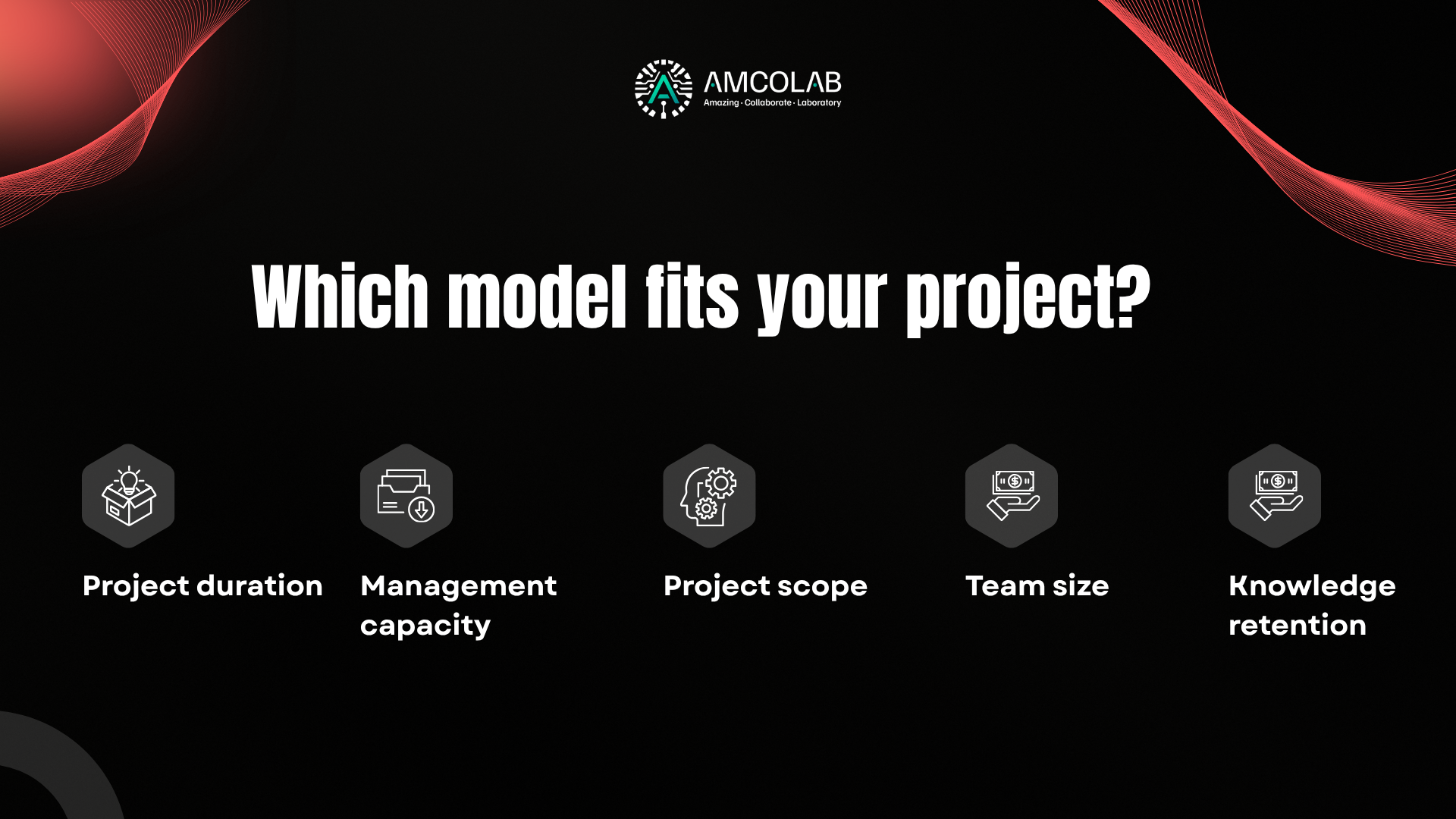
Which model fits your project?
If you're still deciding, these five questions can help point you in the right direction.
- Project duration: Is this a short-term initiative lasting only a few months, or a product that will continue evolving over the next year?
- Management capacity: Do you have experienced technical leaders with enough time to manage additional developers every day?
- Project scope: Are the requirements already well defined, or will they continue changing as the product grows?
- Team size: Do you only need one or two specialists, or an entire cross-functional engineering team?
- Knowledge retention: Will documenting the work be straightforward, or do you need a long-term team to build and preserve product knowledge?
Your answers to these questions usually make the right engagement model much clearer.
Scale your engineering team with AMCOLAB
The decision between Staff Augmentation and a Dedicated Outsourcing Team isn't simply about finding the lowest development cost.
It's about choosing the operating model that best matches your roadmap, your internal management capacity, and the complexity of your product.
At AMCOLAB , we help businesses scale in the way that makes the most sense for their situation.
Whether you need experienced developers to strengthen your existing team or a fully managed engineering squad to own an entire product stream, we build engagement models around your business goals - not the other way around.
Our teams support companies in:
- Building scalable web, mobile, and enterprise software.
- Developing AI-powered applications and business automation solutions.
- Modernizing legacy systems while preserving critical business logic.
- Scaling engineering capacity without the delays of traditional hiring.
If you're planning your next product milestone and evaluating how to scale your development team, we'd be happy to help you choose the approach that fits your business best.