The Biggest Mistake Teams Make When Adopting AI in Software Development
AI can dramatically improve software development productivity, but many teams unknowingly create technical debt by relying too heavily on AI-generated code. This article explores the most common mistake in AI-assisted development and how engineering teams can maintain quality, scalability, and long-term ownership while working faster.
AI in Software Development: The Biggest Mistake Teams Make When Using AI Coding Tools
Artificial Intelligence is transforming software development faster than most engineering teams expected.
Today, developers can generate APIs, database schemas, user interfaces, test cases, and even complete application features within minutes using tools such as ChatGPT, GitHub Copilot, Cursor, and Claude Code.
The productivity gains are undeniable.
Development cycles become shorter. Repetitive coding tasks require less effort. Teams can prototype ideas faster and ship features more quickly than ever before.
At AMCOLAB, we actively use AI throughout our software development process.
However, after working with numerous software projects, we have observed one critical mistake that many teams make when adopting AI.
The problem is not Artificial Intelligence itself.
The problem is treating AI as a replacement for engineering discipline.
Why AI Is Transforming Software Development
Modern AI coding tools have become powerful engineering assistants.
They can help teams:
- Generate code faster
- Create automated tests
- Write technical documentation
- Suggest architectural approaches
- Identify bugs
- Improve developer productivity
- Accelerate MVP development
For businesses, this means faster product delivery and lower development costs.
For engineering teams, it means spending less time on repetitive implementation tasks and more time solving business problems.
But speed creates a new challenge.
The faster software is built, the easier it becomes to create long-term technical problems if engineering quality is not maintained.
The Biggest Mistake: Letting AI Drive the Architecture
Many teams initially experience significant productivity improvements after introducing AI coding tools.
Development appears more efficient.
Features are delivered faster.
Engineering output increases.
Everything seems to be working well.
Then the product grows.
A production issue appears.
A new engineer joins the team.
A customer requests a major feature update.
The application becomes more complex.
Suddenly, the team realizes something important:
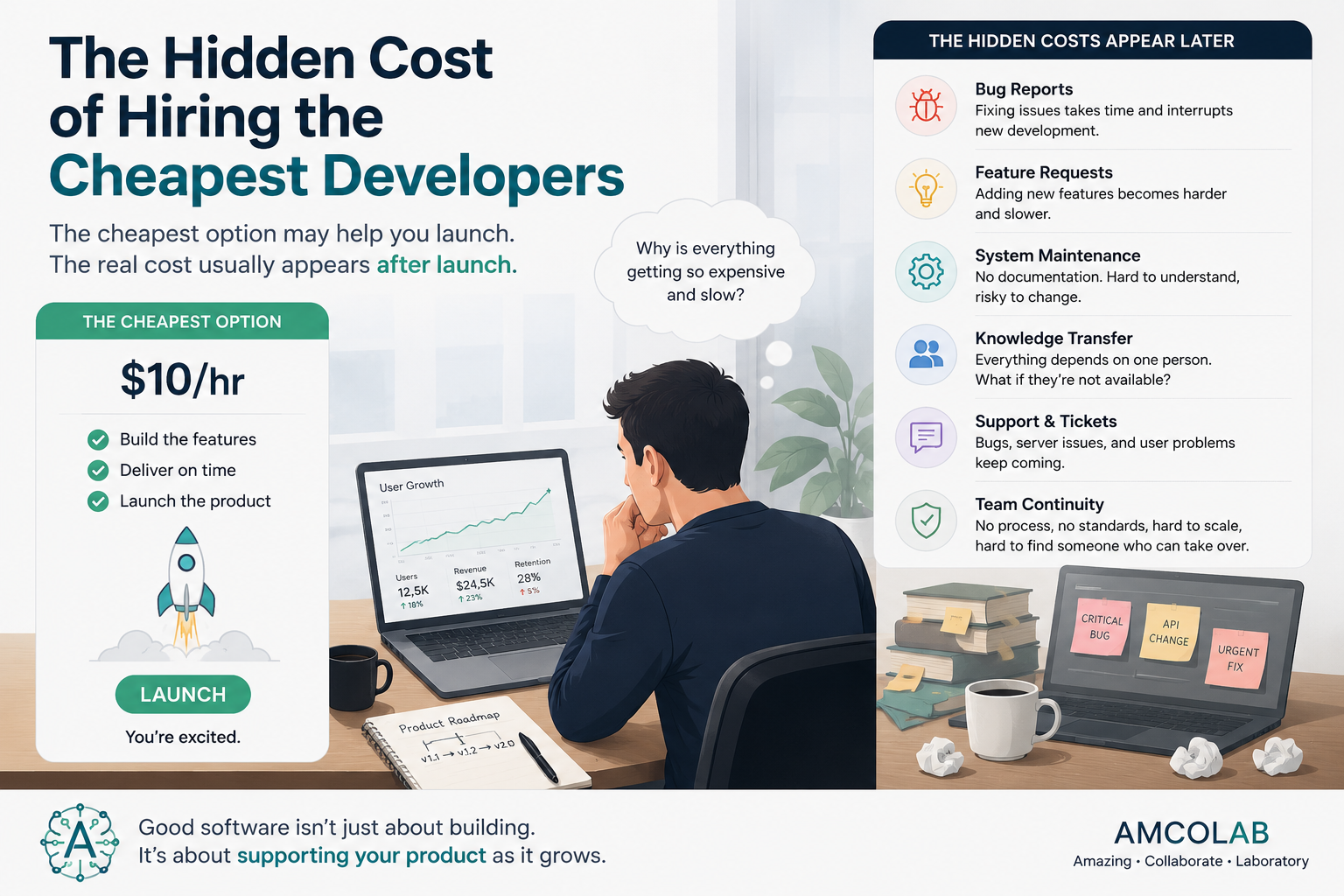
Nobody fully understands how the system works anymore.
This is one of the most common risks associated with unmanaged AI-assisted development.
When engineers rely heavily on generated code without maintaining architectural control, software systems gradually become harder to maintain.
Common Problems Created by Uncontrolled AI Development
Architectural Inconsistency
AI tools often generate technically correct code.
However, different prompts may produce different implementation patterns for similar problems.
Over time, this can result in:
- Inconsistent system architecture
- Multiple coding styles
- Different design patterns solving the same problem
- Increased maintenance complexity
The software works, but the structure becomes increasingly difficult to manage.
Growing Technical Debt
AI accelerates development.
Unfortunately, it can also accelerate technical debt.
Without proper review processes, teams often accumulate:
- Duplicate business logic
- Unnecessary dependencies
- Poorly structured modules
- Redundant code
These issues may remain hidden during early development stages.
As the product scales, they become expensive to fix.
Reduced System Ownership
One of the biggest risks of AI-generated code is reduced engineering understanding.
Developers may accept generated solutions without fully understanding:
- Why the code works
- How components interact
- What assumptions were made
- How future changes may impact the system
When production issues occur, troubleshooting becomes significantly more difficult.
Documentation Becomes Outdated
Many teams rely on AI to generate documentation.
However, documentation often becomes obsolete quickly if processes are not maintained.
As systems evolve, documentation may no longer accurately reflect the current architecture.
This creates additional operational risk for growing teams.
AI Should Accelerate Development — Not Replace Accountability
At AMCOLAB, AI is integrated into our daily software development workflow.
We use AI for:
- Rapid prototyping
- Repetitive coding tasks
- Documentation support
- Test generation
- Research
- Code review assistance
However, AI operates within a structured engineering process.
Every project still follows the same core principles:
Requirements Are Reviewed First
Understanding business requirements remains a human responsibility.
AI can assist with analysis, but engineers must validate business objectives before implementation begins.
Architecture Is Designed Before Code Is Generated
System architecture should never be determined by AI output alone.
Technical decisions must align with scalability, maintainability, and long-term business goals.
Code Reviews Remain Essential
Every significant change should be reviewed by experienced engineers.
Human oversight helps maintain consistency and quality.
Critical Business Logic Requires Human Validation
AI can generate solutions.
People remain responsible for ensuring those solutions are correct.
Controlled Deployment Processes Matter
Software releases require testing, validation, monitoring, and accountability.
AI cannot replace operational governance.
The Teams Winning with AI Are Not Writing the Most Code
A common misconception is that success with AI means generating more code faster.
In reality, the most successful software teams are those that combine AI productivity with strong engineering practices.
They focus on:
- Architecture consistency
- Code quality
- Maintainability
- Technical ownership
- Long-term scalability
- Operational reliability
AI becomes a force multiplier rather than a source of technical chaos.
How Businesses Should Evaluate AI Development Partners
When selecting a software development partner, businesses should look beyond AI adoption itself.
More important questions include:
- How does the team maintain code quality?
- What review processes exist?
- How is technical debt managed?
- Who owns architectural decisions?
- How are AI-generated changes validated?
The real competitive advantage is not having access to AI.
Everyone has access to AI.
The advantage comes from knowing how to use it responsibly.
Conclusion
AI is fundamentally changing software development.
It enables teams to build faster, automate repetitive work, and improve engineering productivity.
However, speed alone does not create great software.
Without proper architecture, governance, and engineering discipline, AI can generate long-term technical debt just as quickly as it generates code.
The future belongs to teams that successfully combine AI capabilities with strong software engineering principles.
Because when products reach real users, maintainability, reliability, and system understanding matter far more than how quickly the code was originally written.
Partner With AMCOLAB
AMCOLAB helps businesses build scalable software solutions through custom software development, AI-assisted engineering, web applications, mobile applications, and digital transformation services.
Our focus is not simply delivering code faster.
Our focus is delivering software that remains reliable, maintainable, and scalable as your business grows.
📧 Email: info@amcolab.vn
📞 Tel: (+84) 968 703 531
🌐 Website: https://amcolab.vn